The Long and Winding Road from Canada to Tennessee
Bruce Springsteen led me to you, Charles.
In 1977, I was fourteen years old and like everyone in the free world, I was enamored, nay astonished, by Star Wars. Here was a story that had everything I wanted. It led me to read much more fantasy and to try my hand at writing it. But there were two problems at the time I couldn’t lick.
First was that as a writer, I sucked. I wrote, as we all do at the beginning, thin copies of whatever I happened to be reading. They had no depth, no passion, no life. The second was a nebulous but growing dissatisfaction with the fantasy genre as a whole. Was this really all there was? Tolkien, Howard, Joseph Campbell and so forth? Was there nothing else, nothing more…real?
Then, in my parallel life as a redneck rock and roll fan, I discovered Bruce Springsteen. Specifically, I discovered Darkness on the Edge of Town. This album did something that the Boss has consistently done for me: he expressed feelings I didn’t realize I had. “Factory” could’ve been about my dad as well as his. “The Promised Land” remains an anthem for how I want to see myself, and the title song a warning about where I might end up. Springsteen has always known how to connect his art to the shared world around us, and that concept became a benchmark for me. If I couldn’t do that, then why was I writing?
And because of that weird mix of influences, when my friend Christi Underdown suggested I try one of your books, Moonheart, I realized I’d found the template for what I wanted to do as a writer: combine mythology with mundanity, show the magic overlapping with our world, mixing in ways that are both new and ancient. Or, as the Boss says on an earlier album, write so that we could “dance all night to a soul fairy band.”
As I worked on creating my own voice as a writer, I continued to read your work. Then I hit Memory and Dream.
There are a handful of books that, as I read them, I carried them with me everywhere so that I could jump back in at any available moment. Foucault’s Pendulum by Umberto Eco was one, as was An Instance of the Fingerpost by Iain Pears and Hawksmoor by Peter Ackroyd. Memory and Dream joined that elite company. I read it everywhere, and finished it one morning at work, before my shift started. I sat in my cubicle crying as quietly as I could, because the novel was so magnificent, so alive (and concerned, of course, with how art can come alive). It remains one of my favorites, both of yours and in general.
One thing I’ve learned is that there’s no such thing as “good” or “bad” art, just art that speaks to you or doesn’t. I’ve heard sincere stories about how the most trite songs, books, or movies have saved people’s lives because they encountered them at the right time. So I’m not going to talk about what’s objectively great in your work, only what speaks to me about it.
When I first encountered it, I was searching for a genre that I didn’t think existed. I grew up in a small Southern town (300 people, 200 of whom were related to me), and while I appreciated the SF/F that let me escape that, I also wanted to find stories that spoke to it. In your work, I found the guide for what I wanted to do: you placed your fantasy in our shared reality. You made the mundane magical, and along with Emma Bull, demonstrated that there was sorcery along the edges of the places we lived. And not only did I need that as a reader, I needed it as a writer. You showed me what these nebulous concepts in my head might look like if they were used by someone with skill, talent, and heart.
More than a few years later, my own first novel, The Sword-Edged Blonde, was about to be released, and I needed the obligatory cover testimonials. I instantly thought of you. Not that we’d ever met; the closest was an e-mail interview I’d done with you for PanGaia magazine. But I asked, and you were gracious enough to accept, providing a wonderful blurb. Since then you’ve also done me the honor of reviewing my books for The Magazine of Fantasy and Science Fiction. You also, I found out later, were friends with another of my favorite authors, one of the least likely connections I can imagine: the master of urban fantasy was pals with the grittiest of realistic crime authors, the late Andrew Vachss.
And this all came full circle when you asked me for a blurb for your novel The Wind in His Heart. I can’t tell you what an honor and blessing that request was for me, and how delighted I was to read the novel in manuscript form.
I also want to say how sorry I am that you (and we) lost Mary Ann. She first invited me to the Mythic Cafe Facebook group, and always had kind things to say about…well, everything. I was never fortunate enough to meet her in person, but having lost my share of people close to me, I can imagine how you must feel, and hope you know that so many of us love you and keep you in our hearts.
So I’ll conclude by saying: thank you, Charles. Thank you for your words, your heart, and your kindness. And thank you for blazing the trail so that others like me might follow.
© Alex Bledsoe
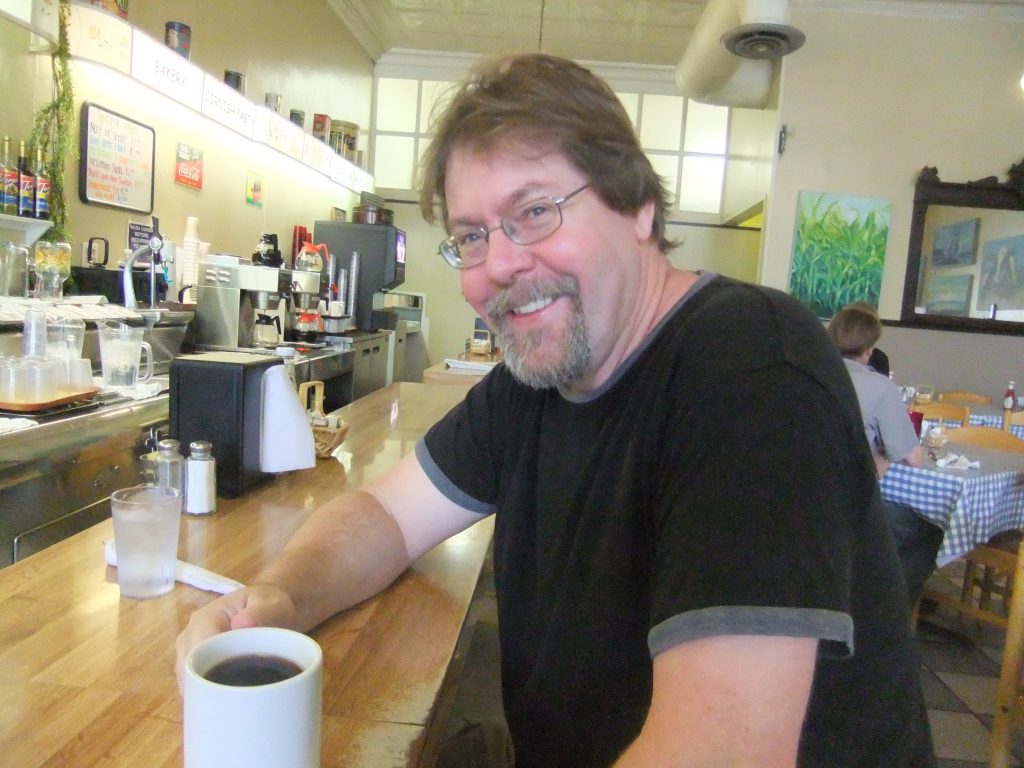
I grew up in west Tennessee an hour north of Graceland (home of Elvis) and twenty minutes from Nutbush (birthplace of Tina Turner). I’ve been a reporter, editor, photographer and door-to-door vacuum cleaner salesman.
I now live in a Wisconsin town famous for trolls, write before six in the morning and try to teach my two kids to act like they’ve been to town before.If you want to keep up with me in real time, follow me on Twitter, Facebook, and/or Instagram. And please feel free to drop me a line via the contact page.
 Celebrating CdL